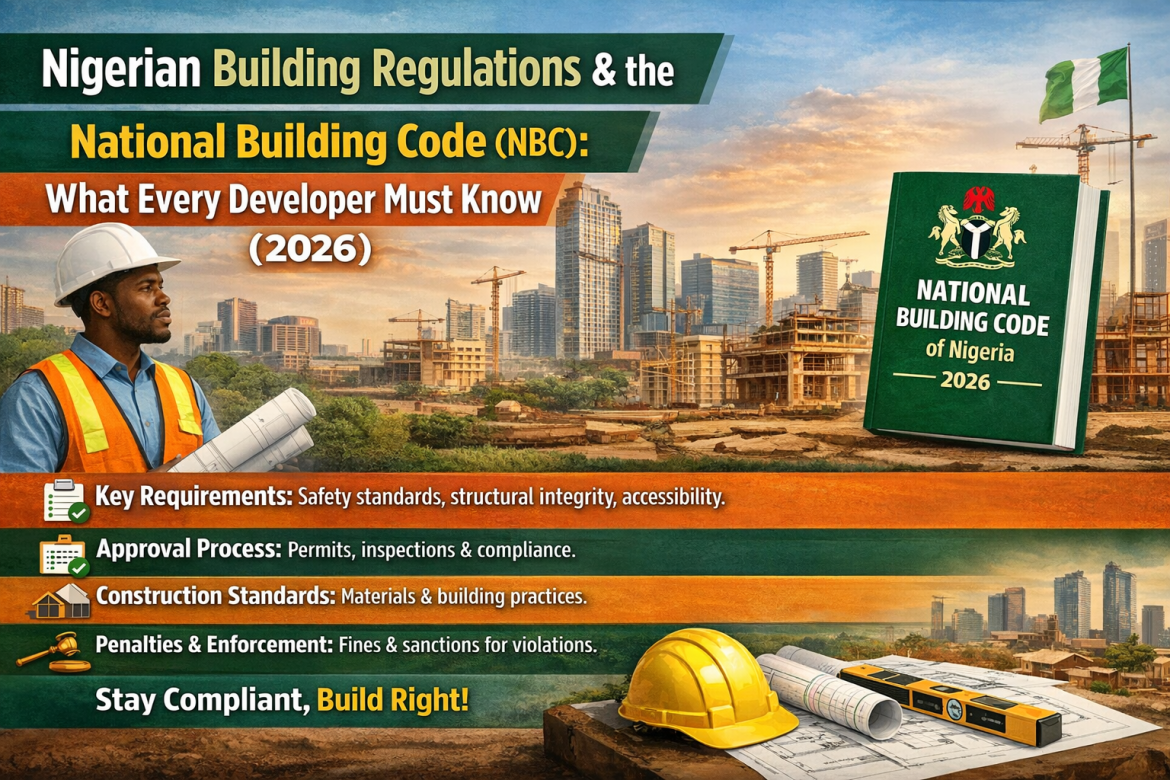
If you’re building in Nigeria, the real “cost” isn’t only cement and steel. It’s also the cost of non-compliance: stop-work orders, redesigns, unsafe structures, avoidable disputes, delayed approvals, and in the worst cases—loss of lives and a total project wipe-out. This guide explains, in practical terms, how Nigeria’s building regulation ecosystem works, where the National Building Code (NBC) fits in, what it expects of developers, and how to organise your project so compliance becomes a system, not a panic at the end. At Conifer Konstruktion, our goal is simple: stress-free construction—built on documentation, professional accountability, and quality you can defend. In Nigeria, building regulations are not one single law sitting in one neat book. They are a stack: State physical planning and urban development laws (these drive planning permits and development control). Building control rules (inspections, structural safety checks, stage certifications, completion certification). National benchmark standards, including the National Building Code (NBC)—which provides minimum requirements for safety and professionalism across the building lifecycle. Special compliance requirements tied to the building type—fire safety, accessibility, environmental rules, utilities, and sometimes sector-specific guidelines. So when clients ask, “Do we really need to follow all these standards?”—the honest answer is: Yes, if you want a building you can safely occupy, insure, lease, sell, or operate without regulatory trouble. And yes, if you want a project that doesn’t turn into a stressful, expensive battle later. The National Building Code of Nigeria (NBC, 2006) was developed to provide minimum standards across pre-design, design, construction, and post-construction stages—largely to tackle recurring problems like poor planning, building collapse, quackery, fire disasters, substandard materials, and weak regulation. Here’s the key point many developers miss: The Federal Ministry responsible for housing has repeatedly positioned the Code as a national reference and encourages state adoption into state law for effective local implementation. In other words: The NBC is your minimum expectation for safety and professionalism. Your state’s planning and building control institutions are usually the ones with teeth—permits, inspections, enforcement actions. Practical takeaway: Build your compliance plan around both: the NBC minimum standards, and your state’s permit and building control processes. The NBC is built around the building lifecycle. Even if you never open the full document, you must organise your project like the Code expects: This is where many Nigerian projects fail quietly—because people rush to drawings without facts. What matters here: Land/title sanity checks Site constraints and access Early risk review: drainage, flooding history, nearby loads, right-of-way issues Conifer note: We treat pre-design as “foundation of certainty.” If you skip it, you may pay twice later. Design is not only “beauty.” It’s buildability, safety, and coordination. What regulators care about: Qualified professionals preparing and endorsing drawings Structural adequacy and detailing Fire safety provisions (depending on occupancy) Proper MEP concept planning—especially for multi-storey and commercial buildings Construction is where compliance becomes visible: quality of materials workmanship inspections documentation This is where developers get stuck—trying to “regularise” what should have been managed from day one. The NBC speaks to post-construction responsibilities, and the Ministry highlights the expectation of a Building Maintenance Manual as part of responsible building delivery. Across Nigeria, enforcement is typically layered: Handled by state physical planning / urban development authorities. Handled by building control agencies/units where established. Lagos is the clearest example because it explicitly separates planning permit and building control functions in its ecosystem: Lagos’ urban planning framework and building control approach are grounded in its planning law. Lagos State Building Control Agency (LASBCA) describes core responsibilities including stage inspections and issuance of certificate for fitness for habitation after completion. Even if you’re not in Lagos, the Lagos structure is a useful mental model: Permit approves what you intend to build. Building control validates what you actually built. If your state has weaker building control, then your own internal quality system must be stronger—because risk doesn’t reduce just because enforcement is weaker. One of the Ministry’s headline points about the NBC is professional accountability—that building works should be prepared and executed by registered professionals, and the Code discourages quackery and untested materials. For developers, this matters for three reasons: Approvals and inspections tend to go smoother when documents are properly produced and signed. Risk transfers properly: when a registered professional is accountable, you’re not building on hope. Your building becomes defendable: if a dispute arises, you can show a chain of competent decisions. Conifer approach: We don’t “start building.” We start by assigning competence—architectural, structural, services, QS/cost control, HSE/quality. That’s how stress reduces. The NBC covers a wide range of requirements. As a developer, you don’t need to memorise clauses—but you must be able to answer these questions clearly: Is the foundation suitable for the soil? Are columns/beams properly detailed and constructed? Is reinforcement correctly placed and protected (cover)? Is concrete quality controlled? Basic fire safety provisions appropriate to the building type Safe access and egress (stairs, exits, corridors) Reasonable ventilation and lighting Safe electrical distribution and earthing Nigeria’s disability law expects public buildings to be constructed with accessibility aids like ramps and lifts where necessary. A building that cannot be maintained becomes a future hazard. The Ministry’s NBC highlights include the idea of a Building Maintenance Manual. Because that is where enforcement tends to land. Nigeria has developed and published national guidance and a Building Energy Efficiency Code (BEEC) process, intended to provide minimum energy efficiency requirements that can be adopted across states. Even where strict enforcement is still evolving, energy efficiency affects real outcomes: thermal comfort (especially in hot climates) generator/utility cost long-term operating cost marketability (tenants like predictable power bills) Developer reality: If your building will be operated for 10–30 years, operating costs can quietly exceed “construction savings” from cutting corners. Conifer approach: We integrate passive strategies early (orientation, shading, ventilation logic) before adding expensive mechanical fixes. Think of compliance like a file you can open at any time and prove: Survey plan Soil test/geo report summary (where applicable) Concept feasibility notes: drainage, access, setbacks, services Architectural drawings Structural drawings + design basis MEP drawings (where applicable) Specifications (materials + workmanship expectations) Professional endorsements/seals where required Approved drawings on site Material approvals (cement, rebar, blocks, aggregates) Concrete test records (cubes/slump—where used) Inspection records (internal + regulator where applicable) Variation log (what changed, why, who approved it) HSE plan and site safety logs (especially for corporate/industrial) As-built drawings (what was actually built) Equipment manuals + warranties Maintenance plan/manual (even a simplified one) Completion certificates where required by building control bodies If you build these packs as you go, you stop begging for compliance at the end. It functions as a national benchmark. The Federal Ministry encourages states to adopt it into their legal and enforcement frameworks for local implementation. Common causes: incomplete documentation unclear land status design inconsistencies (arch vs structural vs services) changes on site without formal variation handling backlog at agencies (varies by state) Accessibility expectations are strongest for public buildings under Nigeria’s disability law. Permit approves your development proposal; building control focuses on compliance during construction and often issues completion certification in jurisdictions with structured building control. Lagos’ building control framework explicitly treats stage inspection and completion certification as core responsibilities. If you’re planning a project (residential, commercial, institutional, or industrial), Conifer Konstruktion can help you build with clarity. Feel free to Contact us. Nigerian Building Regulations: What Every Developer Must Know.
What “building regulations” really mean in Nigeria
Where the National Building Code fits (and why it matters)
The NBC is a national benchmark—states enforce through their own laws
The 4 stages the Code expects you to control (the “compliance mindset”)
A. Pre-design stage
B. Design stage
C. Construction stage
D. Post-construction stage
The Nigerian enforcement reality: who actually controls what?
Planning Permit (development approval)
Building Control (technical supervision + stage inspections)
Professional accountability: the Code is anti-quackery by design
What the NBC expects you to get right (without drowning you in technicalities)
1) Is the building safe structurally?
2) Is the building safe for occupants?
3) Is the building accessible where it should be?
So if you’re developing public-facing property—schools, hospitals, worship centres, offices, malls—accessibility is not “nice to have.” It’s a legal and ethical expectation.4) Is the building maintainable?
That pushes developers toward documentation: what was installed, how it should be serviced, and what warranties exist.5) Are you following your state’s permit + inspection process?
Energy efficiency is no longer optional “extra”—it’s becoming baseline
The compliance pack you should have (so approvals don’t become chaos)
A. Site + pre-design pack
B. Design pack
C. Construction pack (this is where serious developers separate themselves)
D. Completion pack
FAQs (people ask these every week)
“Is the National Building Code a law everywhere in Nigeria?”
“Why do approvals take long sometimes?”
“Do I need accessibility features for a private residence?”
However, basic accessibility thinking (door widths, step-free access options) is increasingly considered good practice for long-term value.“What is the difference between permit and building control?”
Conclusion
 Conifer Konstruktion (Nig) Ltd has a project delivery track record of 60+ projects. Contact us via email (okoyeebubedike@coniferkonstruktion.com.ng) or phone (803) 404-0894, and we’ll make sure you’ll have a stress free construction experience.

Related Articles


1 Comment
-
Kindly share your experience with the building regulatory practice in Nigeria.

