
Nigeria’s building construction industry is powered—quite literally—by energy. Diesel runs heavy equipment and haulage. Petrol powers generators where grid supply is unreliable, it also powers the cars and buses that bring construction personnel to and from work. Aviation fuel affects air cargo and transport economics. Even more importantly, fuel import bills influence foreign exchange (FX) pressure, inflation, and the cost of imported construction inputs. So, when Nigeria’s refining landscape changes, construction outcomes change too—cost, availability, delivery timelines, project risk, and investor confidence. That is why the ramp-up of the 650,000 barrels-per-day Dangote Refinery is not only a downstream petroleum story; it is a structural development with far-reaching implications for how buildings are delivered across Nigeria. The shift underway is clearer in the trade data: as local refining expands, Nigeria’s export basket begins to tilt away from “raw crude dominance” toward “value-added refined products,” while the import burden of refined fuels reduces. This article provides a thematic review—a structured, construction-focused reading of this transition—showing how the Dangote Refinery (and supporting rehabilitation of facilities like Port Harcourt) can reshape the construction economy through 2026 and beyond. Instead of treating the refinery as a distant macroeconomic event, we translate the trend into practical realities: what it means for project owners, contractors, procurement teams, and the entire construction supply chain. From excavation to concrete pours, fuel reliability determines whether a site works smoothly or stalls. To understand the construction implications, it helps to first summarize the energy-trade shift in plain terms: More crude is being retained for domestic processing. Crude export value has shown declines year-on-year (YoY) in some periods, while “other oil products” have risen sharply. Refined product exports are rising while refined product imports decline, strengthening the refined-products trade position. This last point matters for construction because construction pricing in Nigeria is highly sensitive to (a) FX availability and (b) inflation expectations. When the fuel import burden reduces and refined export earnings rise, the macro environment can become less volatile—sometimes not immediately, but directionally. Nigeria’s export mix is shifting: less crude dominance, more value-added refined-product trade. In Nigerian construction, fuel is not just a cost item—it is a schedule lever. When diesel is scarce or prices spike, projects suffer in predictable ways: excavation and earthworks slow down (equipment hours reduce); haulage of cement, sand, granite, reinforcement and blocks becomes erratic; site generators run fewer hours (impacting site lighting, pumping, cutting, welding, water supply); contractors widen contingencies to cover uncertainty. Local refining changes the probability of these shocks—not eliminating them, but reducing their frequency and intensity if supply chains function. Evidence of large-scale product flows began emerging during Dangote’s ramp-up. For example, Reuters reported that gasoil (diesel) exports from the refinery reached nearly 100,000 bpd in May 2024, with the bulk going to other West African countries—a sign of meaningful surplus production at certain points in the ramp curve. Why does that matter for Nigerian construction? Because surplus capacity tends to do two helpful things domestically: it reduces panic-driven local shortages (when distribution works), and it encourages market participants to price with less “fear premium” over time. Construction impact pathway (practical): Generators & site operations: more stable petrol/diesel availability reduces work stoppages. Haulage: fuel stability improves reliability of material delivery schedules. Plant & equipment: contractors are more willing to mobilize equipment when fuel logistics is predictable. Cost planning: reduced volatility improves estimate accuracy and reduces disputes over price escalations. When fuel supply is stable, contractors can sustain night shifts and protect delivery timelines. Even if a refinery produces enough fuel, construction only benefits when fuel reaches markets efficiently. This is where Dangote’s evolving distribution approach becomes relevant beyond oil and gas. Reuters reported that Dangote planned a major logistics upgrade, including importing 4,000 natural gas-powered trucks to support local fuel distribution and direct supply strategies. This matters to construction because a substantial portion of construction inflation is not strictly “material price”; it is delivered price—the cost of moving materials and fuel over difficult road networks, across long distances, with multiple points of friction. Lower logistics cost component in fuel pricing (especially for large industrial users, when direct supply works). More predictable replenishment cycles, reducing the “stock-out” behaviours that inflate prices. Potential for structured supply contracts for large consumers (manufacturers, telecoms, possibly large contractors), which improves planning. Fuel distribution does not just affect diesel and petrol. It affects the movement of: cement (from plants to cities and semi-urban areas), rebar and steel profiles (often distributed from major commercial hubs), tiles, sanitary ware, electrical accessories (sensitive to both FX and logistics), blocks and aggregates (short-to-medium distance but high frequency), site labor mobility and subcontractor scheduling. In other words, better energy logistics can have second-order effects: it reduces the “delivery friction” that often makes project costs behave unpredictably across states and seasons. Refining capacity matters—but distribution is the bridge that turns production into real-world price and availability. Many Nigerian building inputs are either imported or priced as if they were imported. That’s because even when an item is locally available, suppliers always benchmark against FX-driven replacement costs. So, when Nigeria reduces refined product imports and earns more from refined exports, it can influence: FX availability (or at least reduce demand pressure), inflation expectations, and pricing behaviour in construction supply markets. CBN’s Q3 2025 highlights show the refined-products trade moving in a supportive direction: exports increased to $2.29bn, while imports declined to $1.65bn in the same quarter. This is not a guarantee that the naira strengthens or that construction prices fall. But it is part of the mechanism through which macro volatility can reduce—particularly if complemented by stable crude supply, stable refinery operations, and a predictable policy framework. Finishing materials and building systems Equipment and spares Professional services and technology When FX pressure reduces (even slightly), supply chains become more willing to quote stable prices, extend validity periods, and negotiate structured payment terms—key for predictable project delivery. Policy and supply rules shape construction outcomes by influencing local fuel availability and price stability. A frequent mistake in public conversations is assuming that local refining automatically means “no more fuel risk.” In reality, policy and crude supply governance still shape outcomes. Nigeria’s upstream regulator has enforced the logic of a Domestic Crude Supply Obligation (DCSO) more strongly in the refining era. They maintained that Nigeria would block export permits for producers who do not meet refinery supply quotas, warning that diversion of crude meant for domestic refining contravenes the law. Even at that, the local refineries are not supplied with sufficient quantities of feedstock to enable them operate continuously without supply induced downtime. Construction is affected by fuel stability. Fuel stability is affected by: crude availability to local refineries, refinery uptime and maintenance performance, distribution and pricing decisions, regulatory enforcement. When domestic supply obligations are enforced, they support refinery feedstock security—which supports product availability. But policy actions can also introduce short-term uncertainty if market participants react, especially during transition periods (e.g., disputes over pricing, allocation, or logistics). Even in a local refining era, contractors should keep disciplined risk controls: include clear fuel escalation clauses, maintain supply buffers for critical phases, avoid single-point dependency in fuel procurement (where possible), use project controls to minimize idle time and fuel waste. Nigeria’s refining era is global: inputs, blendstocks, and product cargoes can move across borders. One of the most revealing signals of Nigeria’s new refining complexity is the reported shift in crude trade flows. Reuters reported that the U.S. became a net exporter of crude to Nigeria in February and March 2025, a reversal linked to market dynamics and refinery demand (including Dangote’s crude input needs). This is important because it tells construction stakeholders something practical: local refining does not mean local isolation. Refining is an optimization business. Product quality targets, blending requirements, crude quality differentials, and global arbitrage opportunities can all shape what happens next. Fuel prices may not collapse simply because production is local. But supply reliability and availability can still improve significantly. Price volatility can reduce over time—especially if domestic supply logistics become structured. As value-added exports grow, industrial activity can rise—pulling demand for warehouses, factories, and infrastructure. Construction demand is partly a function of confidence. When industrial investors believe costs will be predictable and supply chains will be stable, they build: factories, logistics parks, warehouses, staff housing, commercial facilities, port-adjacent infrastructure. CBN’s reporting that refined product exports increased strongly in Q3 2025 is one of the signals feeding this confidence narrative. Even if overall macro conditions remain tough, the direction of travel matters: value-added exports and reduced imports can strengthen national capacity to plan and fund infrastructure and industrial growth. A successful refining ecosystem can pull construction demand in several segments: Industrial construction: storage tanks, warehouses, processing facilities, maintenance workshops, utilities infrastructure. Transport infrastructure: road rehabilitation, port upgrades, trucking depots, industrial corridors. Real estate and housing: staff accommodation, mixed-use developments around industrial zones. Commercial services: retail, offices, hospitality—often following industrial clusters. This is not automatic, but it is a common pattern in economies where energy and industrial policy begin to produce visible trade outcomes. Multiple refining nodes strengthen supply resilience and can stabilize fuel access across construction corridors. Dangote is the headline, but system resilience improves when there are multiple functional refining nodes. Nigeria’s state-owned refineries have long been a story of underperformance, but rehabilitation efforts remain part of the national strategy. The existence of opertional and under construction modular refineries across the nation also contributes the resilience of the petroluem refining industry. This is achieved through the availability of extra refining capacity even when the large refineries undergo periodic turnaround maintenance. Construction projects across the South-South, South-East, and parts of the North benefit when supply does not rely on a single mega facility. Multi-node refining and distribution can: reduce regional scarcity, reduce the “single-shock” risk (maintenance outage at one facility affecting national supply), improve competition dynamics and reduce extreme pricing behaviours. Even if Dangote remains the dominant private anchor, additional functioning capacity contributes to a more stable fuel ecosystem—which construction values because construction thrives on predictability. Where the refinery impact shows up first: haulage-heavy materials, equipment hours, and site utilities. It is tempting to measure refinery impact by one headline: “fuel is cheaper.” But construction leaders know the truth: the biggest gains often come through risk reduction, not only unit price. Here are the construction cost categories most likely to respond to improved fuel availability and trade stability: cement and block supply chains, reinforcement and structural steel deliveries, sand/granite for concrete works, roofing and finishing materials moved from hubs to project locations. Fuel is a primary cost input in trucking. If supply stabilizes, haulage firms price more predictably, and contractors can negotiate structured delivery terms rather than reactive spot pricing. Nigeria’s construction ecosystem increasingly relies on equipment rentals: excavators, loaders, graders, rollers, cranes, forklifts. Rental pricing often reflects fuel logistics risk and maintenance costs. If diesel supply becomes smoother and spare parts procurement is less FX-chaotic, rental markets can become more competitive and stable. Temporary power, water pumping, and site lighting are essential—especially in early and mid project phases. Fuel stability reduces the “stop-start” nature of work that often causes rework, poor quality outcomes, and schedule slippage. Macro stability helps—but governance and reporting convert stability into predictable project delivery. For diaspora and corporate project owners, the biggest fear is uncertainty: uncertainty in cost, uncertainty in timeline, uncertainty in quality controls, uncertainty in procurement and site reporting. A more stable energy and FX environment reduces one layer of uncertainty, but it does not replace process discipline. In fact, when the macro environment improves even slightly, the firms that win are those that convert macro stability into micro execution reliability through: transparent project reporting, disciplined procurement governance, clear variation and cost control, quality assurance systems, predictable milestone delivery. This is where a construction company’s internal systems matter as much as market conditions. Macro stability gives the opportunity; project governance captures the value. A practical response: tighter planning, smarter procurement, and disciplined monitoring in a changing energy economy. This thematic review becomes useful only if it leads to action. Here is how different stakeholders can respond to the refining shift. If you are planning to build in 2026 and beyond, treat energy stability as an opportunity to tighten planning discipline: insist on a detailed project schedule linked to procurement lead times; demand transparent cost breakdowns with explicit logistics assumptions; approve escalation clauses that are fair but controlled, rather than ambiguous contingencies. Convert “better supply probability” into operational excellence: reduce idle time and improve daily planning; restructure deliveries into fewer, better-coordinated trips; negotiate fuel supply arrangements during peak phases (earthworks, concrete works, mass blockwork). Use the new environment to improve buying strategy: renegotiate supply terms with longer quote validity windows when possible; establish framework agreements for high-volume recurring materials; build alternative supplier lists to prevent single-point disruptions. Monitor the industrial and FX signals: improved refining outcomes can support medium-term demand for industrial property and housing near industrial corridors; align real estate strategy with areas benefiting from new trade flows, manufacturing activity, and logistics upgrades. Predictability is the real win: stable inputs plus disciplined delivery systems create stress-free construction outcomes. The Dangote Refinery’s ramp-up—supported by policy enforcement like domestic crude supply obligations and complemented by rehabilitation efforts such as Port Harcourt—signals a new phase in Nigeria’s energy-trade structure. Official trade statistics show crude export value declines in some periods alongside sharp increases in other oil products, and CBN balance-of-payments data shows refined product exports rising while refined product imports fall. For the Nigerian building construction industry, the most meaningful implication is not a simplistic promise of permanently low fuel prices. The deeper value is risk reduction: fewer supply shocks, better logistics predictability, reduced FX pressure from fuel imports, improved confidence for industrial and real estate investments, a stronger foundation for disciplined project planning. Construction thrives on predictability. When the energy system becomes more predictable, the best construction outcomes follow—but only for teams that pair macro opportunity with strong governance, cost control, and quality execution. The Impact of Dangote Refinery on the Nigerian Building Construction Industry: A Thematic Review
Nigeria’s refining pivot in one snapshot
In 2024, reporting indicated that Dangote retained a meaningful share of Nigeria’s crude export stream for domestic refining—illustrating the first major pull of feedstock into local value addition.
Nigeria’s official trade statistics for Q1 2025 recorded crude oil exports valued at ₦12,955.03bn, down 16.35% from Q1 2024, while “other oil products” exports rose 134.24% YoY (a category that captures refined/processed petroleum items).
The Central Bank of Nigeria’s Q3 2025 balance-of-payments highlights show refined petroleum product exports rising from $1.59bn (Q2 2025) to $2.29bn (Q3 2025), while refined petroleum product imports fell from $1.89bn to $1.65bn.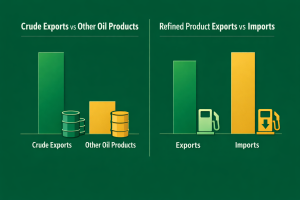
Theme One: Fuel availability and price stability as a new construction “schedule lever”

Theme Two: Logistics transformation—distribution strategy and haulage efficiency
What changes when distribution becomes more efficient?
What it means for construction supply chains

Theme Three: FX pressure, inflation expectations, and the construction materials “import channel”
Where construction feels this most
Imported tiles, sanitary ware, fittings, elevators, specialized doors, façade materials, electrical protection gear, building automation components—these are all exposed to FX fluctuations.
Even locally assembled equipment depends on imported components. When FX volatility increases, contractors face delays in repairs and parts procurement—causing downtime.
Some design software, specialist consultancy, certifications, and imported testing equipment are priced in foreign currencies.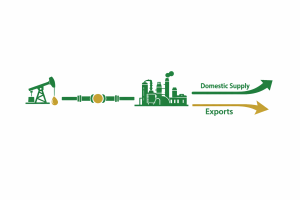
Theme Four: Export success vs domestic obligations—why policy still matters to construction risk
Why construction should care
Construction risk takeaway

Theme Five: “Unusual imports” and the reality of refinery optimization—why fuel prices may not behave simply
What it means on the ground
Theme Six: New export earnings, manufacturing confidence, and construction demand
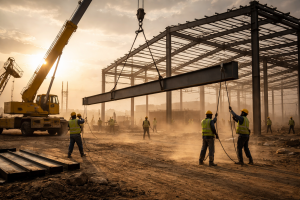
The construction industry’s “demand-side” opportunity

Theme Seven: The other refineries factor—system resilience and regional supply stability
Why this matters for construction

Theme Eight: Construction cost structure—where the refinery effect will show up most
(a) Haulage-heavy inputs
(b) Equipment operations and rentals
(c) Site utilities and temporary works

Theme Nine: Investor confidence, diaspora projects, and the “trust premium” in construction
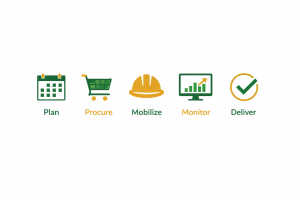
What construction stakeholders should do now (practical playbook)
For project owners
For contractors and construction managers
For procurement teams
For developers and real estate investors

Conclusion: Dangote Refinery’s construction impact is less about “cheaper fuel” and more about “predictable delivery”
 Conifer Konstruktion (Nig) Ltd has a project delivery track record of 60+ projects. Contact us via email (okoyeebubedike@coniferkonstruktion.com.ng) or phone (803) 404-0894, and we’ll make sure you’ll have a stress free construction experience.