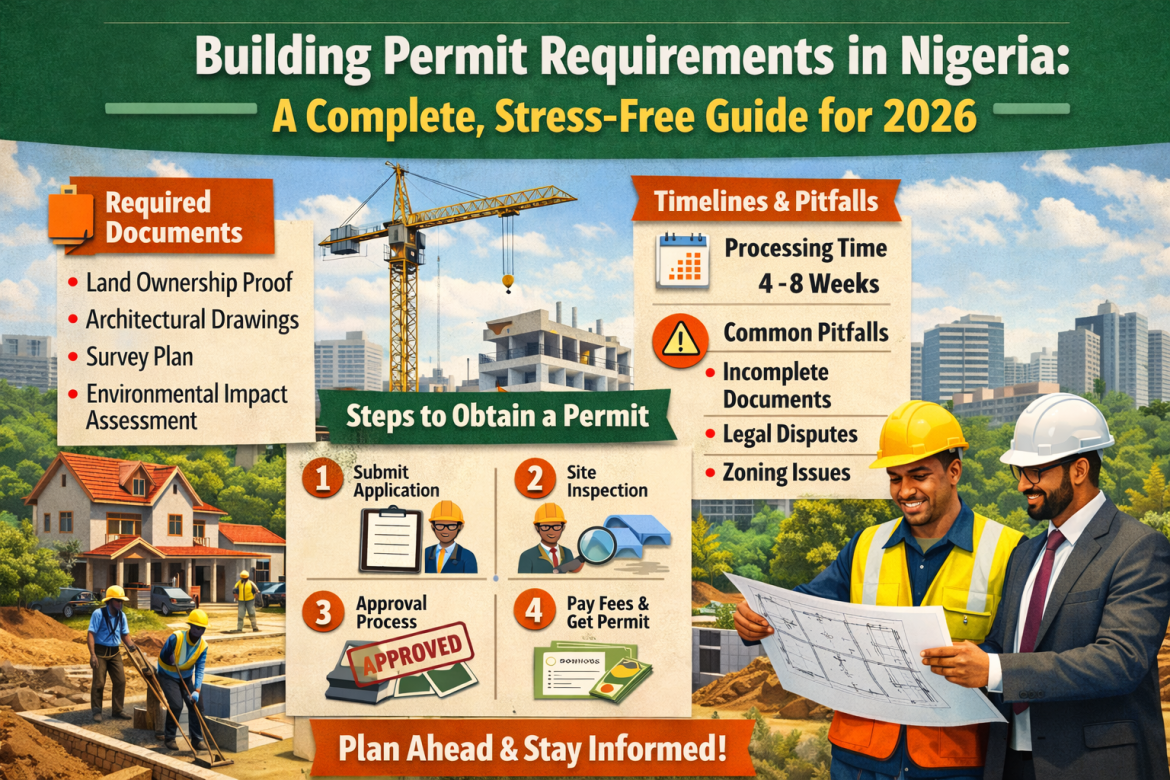
If you’re planning to build in Nigeria—whether it’s a family home in the East, a corporate facility in Lagos, or a diaspora investment you’ll manage from abroad—your building permit is not “paperwork you’ll do later.” It is the foundation of a lawful, safe, insurable, and marketable project. At Conifer Konstruktion, we’ve learned something that saves clients money and sleepless nights: the easiest projects to deliver are the projects that start correctly—with clear title checks, compliant design, proper approvals, and stage-by-stage documentation that can stand up to any inspection. This guide breaks down building permit requirements in Nigeria in plain language, with special attention to how approvals work in strict enforcement environments (especially Lagos), what documents typically trigger delays, and the practical steps that keep your build stress-free. Important note: Regulations vary by state and project type. This article is educational (not legal advice). Always confirm requirements with the relevant state agency or through registered built-environment professionals. Many people use “building approval,” “building permit,” “planning permit,” and “building plan approval” interchangeably. In practice, approvals typically fall into two related lanes: This is permission to develop a specific kind of building on a specific piece of land, under zoning, setbacks, density, right-of-way, drainage, parking, height limits, and other planning rules. In Lagos, for example, the Lagos State Physical Planning Permit Regulations 2019 make it clear that anyone intending to carry out development must apply for a planning permit—and that developments “shall have an approved Planning Permit.” This is the lane that follows your planning permit. It covers construction supervision, inspections, certification, and (in some jurisdictions) completion/fitness certification. In Lagos, LASBCA supervision is often evidenced by processes like stage-by-stage inspection, commencement authorization, and a completion/fitness certificate regime that the state has actively emphasized in recent years. A planning permit is not a land title document, and it does not magically fix land disputes. You still need proper title verification and survey clarity before you start. Nigeria’s construction environment has faced painful realities—building collapses, fire disasters, and the consequences of quackery and substandard materials. The Federal Ministry of Housing & Urban Development has explained that the National Building Code (2006 edition) exists to establish minimum standards across pre-design, design, construction, and post-construction—specifically to address these safety and quality concerns. Many serious buyers, corporate tenants, and institutional investors increasingly ask: Was the development approved? Were inspections documented? Is there evidence of compliance? A “beautiful building” without the right approvals can become a trapped asset—hard to sell, hard to insure, and risky to occupy. Once you’re building above certain scales, insurers, professional teams, and even financiers often require proof of approvals and compliance documentation as part of risk control. In Lagos, public messaging around building control has highlighted that the system is designed to ensure a structure is safe and fit for habitation, with supervision evidenced by authorization to commence and a stage-by-stage inspection process, culminating in completion/fitness expectations. If you’re abroad, your approvals become part of your “remote control dashboard.” When everything is documented, you are no longer depending on verbal assurances—you can verify progress, compliance, and quality from anywhere. That is what we mean by Stress-Free Construction. Nigeria’s National Building Code provides a national reference point for standards—covering professional responsibilities, safety, structural integrity, fire considerations, and enforcement concepts. The Federal Ministry has emphasized that it sets minimum standards and encourages state governments to adopt and enforce it through their laws. Your actual permit process is mainly driven by the state (and sometimes local or metropolitan development control structures), because physical planning and building control are executed through state and local government council agencies. Lagos has a structured planning permit framework under LASPPPA regulations (2019). The Federal Capital Territory has Development Control structures and has pushed online/automated elements in parts of its process. So, yes—Nigeria has national standards, but your permit checklist and workflow depend heavily on where you’re building. Below is a practical, field-tested workflow we use to keep projects compliant and predictable. Even if the names of agencies differ across states, the logic is broadly consistent. Before you pay heavily for full drawings, confirm: Survey authenticity (coordinate accuracy, boundary clarity) Title status and red flags (government acquisition, disputed families, overlapping claims) Right-of-way and setbacks exposure (roads, drainage corridors, utility easements) Why it matters: Planning authorities frequently reject or delay applications when title and survey documents are inconsistent with the land reality. This is where many projects lose months: beautiful drawings that do not fit planning realities. A good professional team will check: Permissible use (residential, mixed-use, commercial, institutional) Height limitations and density expectations Setbacks, airspaces, and parking requirements Drainage approach and stormwater routing In Lagos, the planning permit framework explicitly covers issues like setbacks, building coverage, parking, building height, and special structures—meaning these are not “optional considerations.” One of the recurring problems in Nigerian permitting is design documentation prepared without proper professional accountability. The National Building Code highlights professional responsibilities and accountability as core to safe development. Even where enforcement varies, projects with properly prepared and sealed documents generally move faster. Most states require, at minimum: Architectural drawings Survey plan Title document(s) For example, Lagos regulations specify that planning permit applications must be accompanied by (at least) an architectural drawing set, a duly signed survey plan, and title documents. You don’t just “submit and wait.” A high-performing permit process includes: A single coordinator (to prevent conflicting responses) A query response log Version control on drawings (so the team doesn’t resubmit old sheets) Some approvals are time-bound. For Lagos, the regulations state that if the holder fails to commence development within two years, the permit becomes invalid (and may require revalidation). This matters more than people realize. If you obtain approval and abandon the site for too long, you may lose time, money, and momentum. This is where many people make a costly mistake: they get planning approval, then start building without properly notifying building control. In Lagos, a widely cited guidance document explains that upon obtaining planning permit approval, the developer is required to give 7 days’ notice in writing to LASBCA of intention to commence works, with supporting documents (including the planning permit, supervision undertakings, HSE report, and, depending on the project, sub-soil investigations and insurance). Lagos building control messaging has also emphasized that authorization to commence and a “green sticker” indicate supervision through stage-by-stage inspection and certification, and that completion/fitness certification is issued after satisfactory completion. Even where your state uses different terminology, the principle is the same: A strong closeout includes: As-built documentation Test certificates where relevant Inspection sign-offs A completion/fitness/occupancy evidence package where applicable This closeout is what protects your resale value, your tenancy readiness, and your peace of mind. Every state has its nuances, but these are common “high impact” documents that repeatedly decide whether an application moves or stalls. Title document(s) (C of O, deed, allocation, governor’s consent—depending on the land history) Survey plan Applicant identification (individual or company incorporation documents where relevant) Architectural drawings (site plan, floor plans, elevations, sections) Structural drawings + calculations (especially for multi-storey buildings) Mechanical and electrical drawings where applicable In the Lagos context, a guidance document lists multiple documentary requirements including stamped architectural drawings, structural drawings, calculations signed by a registered engineer, and (where applicable) MEP drawings and clearance letters. Soil test / subsoil investigation (especially for poor soils or heavier structures) Environmental impact assessment (project-scale dependent) Traffic impact assessments (for larger commercial developments) Drainage clearance expectations in flood-prone contexts Practical truth: Even where “if applicable” is used, planning officers can still request these documents based on your site’s risk profile. Notice of commencement to building control (where required) HSE plan / report Supervision undertakings by professionals involved Programme of works / methodology (for higher risk projects) For Lagos, the “7 days’ notice” guidance lists examples of these items explicitly. This is the honest answer: it depends—but it doesn’t have to be unpredictable. Title/survey clarity (clean documents move faster) Design compliance (zoning/setbacks/parking done correctly) Project type (single-family home vs. multi-storey commercial) State enforcement intensity (Lagos and some metros are typically stricter) Responsiveness to queries (weeks are lost in slow replies) Instead of promising a single number, build your planning around three bands: Fast track (best case): clean title + compliant design + quick query response Normal track: typical back-and-forth plus one or two clarifications Complex track: title regularization, special structure, flood/drainage concerns, traffic impact, or multi-agency clearances In Lagos, note also the practical impact of validity rules—if you do not commence within the required window (e.g., two years in the Lagos regulations), you can be forced into revalidation cycles. If your goal is stress-free delivery, plan approvals as a project in itself: Assign a coordinator Track documents like a construction schedule Use professional sign-offs early Keep a “query response budget” (time + cost) Permit fees vary by state, project type, size, and the specific schedule of fees in force. Avoid anyone who gives you a single “flat number” without seeing: land location and zoning building use (residential, commercial, institutional) volume/area metrics used by the agency special clearances (fire, drainage, transport, etc.) The Lagos regulations themselves recognize categories of fees and that assessment rates can change over time (rates determined “from time to time”). When clients budget only “approval fee,” they get shocked later. We advise budgeting for: Professional design & documentation fees Agency assessment/processing fees Required studies (soil test, EIA/traffic if triggered) Site signage and documentation printing/submission formats Building control compliance steps (inspection readiness, HSE documentation) This is how you keep approvals from becoming a financial ambush. This is the fastest way to attract stop-work actions, enforcement notices, sealing, penalties, or demolition risks—depending on the state. Mismatch between survey coordinates, title names, or parcel descriptions can stall the process indefinitely. If the drawing ignores setbacks, right-of-way, parking, drainage, and height limitations, rejection is not “bad luck.” It’s predictable. Apart from safety risks, this leads to slow processing because agencies increasingly prefer properly signed and accountable documentation, consistent with the National Building Code’s emphasis on professional responsibility. Approvals often fail not because the project is impossible, but because the applicant responds late, incompletely, or inconsistently. In Lagos, guidance explicitly notes commencement notice to building control (7-day notice) and documentation to accompany it. Where validity periods exist (e.g., the Lagos “commence within two years” rule), delayed starts can trigger revalidation requirements and extra costs. At Conifer Konstruktion, our brand promise is not just quality concrete and straight lines. It is clarity—from day one. Here is our typical compliance flow: Title and survey sanity checks Site constraints review (flood history, drainage path, access) Zoning feasibility check Design that respects planning logic Structural design that respects site reality Documentation prepared for approval, not for aesthetics alone Checklist-based packaging Query response tracking Version control on drawings Commencement readiness (where required) HSE discipline Stage documentation so you can defend your project anytime As-built records Quality documentation Evidence pack suitable for serious buyers/tenants That is how we help clients build trust, not tension—and why many diaspora clients say their project finally felt “under control.” If you want a project that finishes on time, stays within budget, and earns trust—start with compliant approvals. The building permit process may feel bureaucratic, but when handled professionally, it becomes a powerful tool: it clarifies what you can build, reduces surprises, and protects your investment. At Conifer Konstruktion, we build with a simple philosophy: Your Project, Our Precision—and we deliver it in a way that keeps you informed, protected, and confident from anywhere in the world. Building Permit Requirements in Nigeria: A Complete, Stress-Free Guide
What “Building Permit” Means in Nigeria (and what it is not)
A. Planning / Physical Planning Permit (Development Permission)
B. Building Control / Construction Stage Compliance
What it is NOT: Land ownership
Why Permits Matter (Beyond “Government Requirement”)
1) Safety and collapse prevention
2) Resale value, leasing, and bankability
3) Insurance and liability protection
4) Utilities and lawful occupancy
5) Peace of mind (especially for diaspora project owners)
The Regulatory Framework: National Benchmark + State Implementation
The National Building Code as a benchmark
Why states matter more in day-to-day permits
The Real-World Permit Journey (A Stress-Free Step-By-Step)
Step 1: Confirm land status (before design goes far)
Step 2: Align design with zoning and site constraints early
Step 3: Engage registered professionals (don’t “manage drawings” casually)
Step 4: Prepare your core document pack (the “minimum viable submission”)
Step 5: Submit and respond quickly to queries
Step 6: Obtain planning permit approval (and understand validity rules)
Step 7: Notify building control and follow inspection/certification steps
Your project needs compliance checkpoints, not just a paper approval.Step 8: Close out properly at completion (protect your future self)
Core Document Checklist (Nigeria-Wide Logic)
A. Land & identity documents
B. Design drawings (prepared by competent professionals)
C. Site condition and impact documents (where applicable)
D. Construction compliance package (often after approval, before or during construction)
Timelines: How Long Does Building Approval Take in Nigeria?
What drives timelines the most
A realistic planning approach (what we recommend)
Our Conifer rule of thumb
Fees: What to Expect (Without Guesswork)
Budget the real cost categories
The Most Common Permit Mistakes (and how to avoid them)
Mistake 1: Starting construction before approvals
Mistake 2: Submitting inconsistent land documents
Mistake 3: Designing “Instagram architecture” that ignores planning realities
Mistake 4: Using non-accountable or unqualified designers
Mistake 5: Failing to manage the query loop
Mistake 6: Forgetting post-approval obligations
Ignoring this stage can derail what looked like a “finished approval.”Mistake 7: Letting approvals expire without revalidation
Conifer’s “Permit-First, Stress-Free” Approach (How we deliver peace of mind)
1) Pre-design due diligence
2) Compliance-led design development
3) Approval packaging and submission management
4) Construction compliance and documentation
5) Closeout that protects resale and occupancy readiness
Conclusion: The Permit is Your Project’s First Quality Test
 Conifer Konstruktion (Nig) Ltd has a project delivery track record of 60+ projects. Contact us via email (okoyeebubedike@coniferkonstruktion.com.ng) or phone (803) 404-0894, and we’ll make sure you’ll have a stress free construction experience.