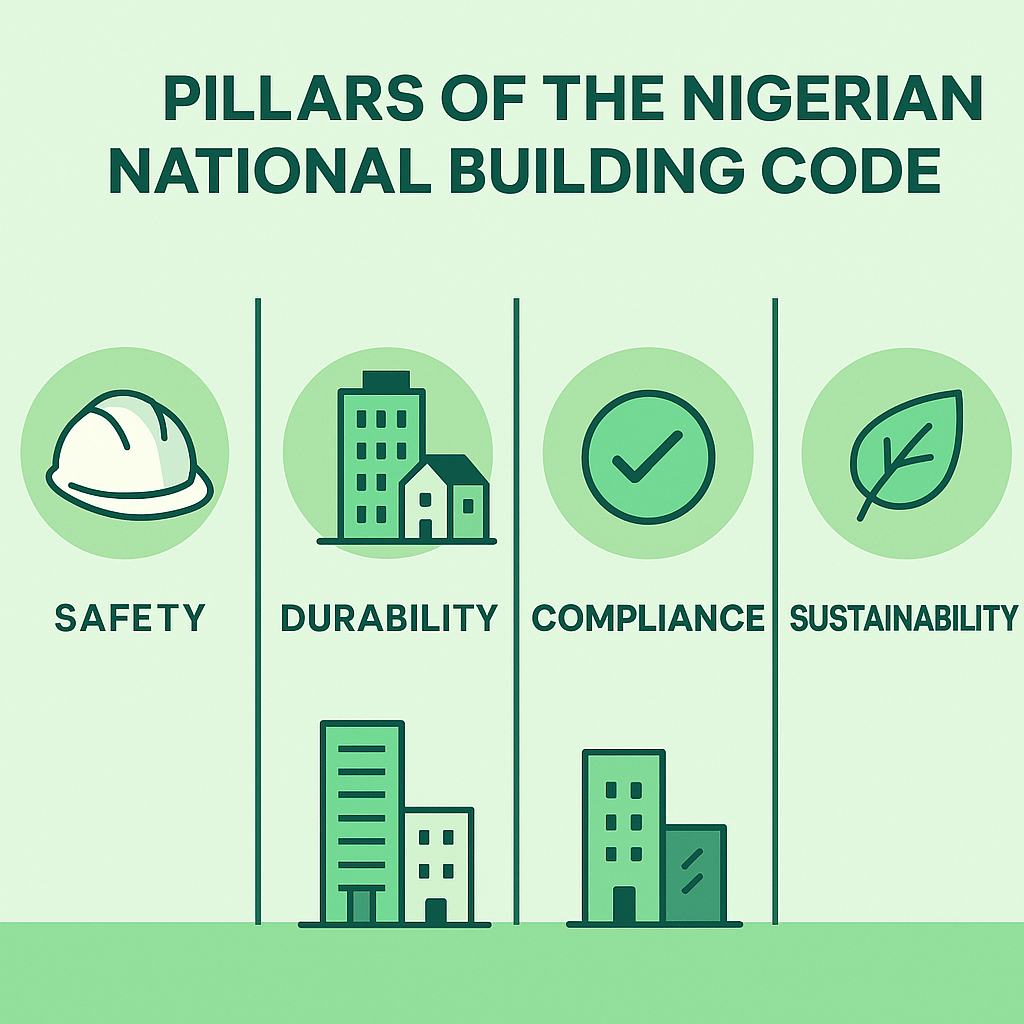
The Nigerian National Building Code (NBC, 2006) is Nigeria’s foundational regulatory framework governing building design, construction, alteration, use, maintenance and demolition. Developed to address rampant substandard construction and recurring structural failures, the NBC establishes minimum enforceable standards across all stages of the built environment lifecycle: from pre‑design through post‑occupancy. Its provisions aim to safeguard public safety, health, welfare, and environmental sustainability. In this review, we examine the NBC’s 14 sections, explore its administrative and technical provisions, enforcement framework, challenges, and the real-world implications. We reference other codes only when their provisions mirror the Nigerian NBC exactly. The NBC’s roots trace back to 1987, following a directive by the National Council of Works and Housing to develop a building code for Nigeria. Successive stakeholder workshops occurred in Badagry (1998), Ijebu‑Ode (1990), and Port Harcourt (2005), culminating in the Federal Executive Council’s approval in 2006. Although never ratified by the National Assembly, the NBC is legally binding by virtue of Federal Executive Council approval and endorsement by the Council of States. It is enforceable across all states, pending domestication into state laws. Federal authorities urge states to integrate NBC provisions into local building laws. The NBC is organized into four Parts, comprising fourteen sections with specific focus areas: Section 1 (Citation) – declares the NBC as statutory guidance within Nigeria. Section 2 (Definitions & Abbreviations) – standardises terminology used across the Code. Section 3 (Administration) – establishes the Building Code Advisory Committee (BCAC), under the Federal Ministry of Housing and Urban Development, with multi‑disciplinary professional representation for code development and technical oversight. Covers design, materials, and practices: Section 4 (Building Design Classification) – classifies buildings by occupancy (residential, commercial, institutional, high‑rise, etc.), establishing minimum requirements for each. Section 5 (Construction Classifications) – details structural elements, load categories, foundation types, and assembly requirements. Section 6 (Environmental & Site Requirements) – mandates site selection criteria including soil testing, topography adaptation, drainage, and minimum setbacks. Section 7 (Architectural Design Standards) – includes minimum requirements for circulation, egress, natural lighting and ventilation, staircases (e.g., 900 mm minimum handrail height), and emergency exit widths. Section 8 (Structural / Geotechnical / Civil Engineering Design) – requires foundation design based on geotechnical analysis; concrete and brick strength; structural reinforcement and minimum load calculation; includes wind load design in coastal zones. Section 9 (Service Engineering: Electrical/Mechanical/Plumbing) – mandates standard design for electrical wiring, earthing, capacity loads, pipe sizing, drainage and potable water supply. Section 10 (Materials & Components Standards) – only approved materials (by SON, COREN, NSC standards) may be used for structural elements, roofing, plastering, and finishes. Section 11 (Construction Practices & Techniques) – insists on professional supervision of critical installations; prohibits unlicensed builders from major works; includes defined inspection milestones. Section 12 (Post‑construction Maintenance & Technology) – requires ongoing structural assessments; high-rises must be surveyed periodically; registers for inspections and maintenance must be maintained. Section 13 (Control of Building Works) – stipulates mandatory plan approvals, inspections at foundation, shell, and finishing stages; issuance of completion and occupation certificates; and sanctions (demolition orders, fines, prosecution) for non‑compliance. Section 14 (Schedules & Standards) – lists referenced technical standards (e.g. SON, COREN, NSE publications) and standard forms for permit, inspection, and occupancy certification. NBC mandates building works be designed and supervised only by duly registered professionals (architects, engineers, builders), each signing off relevant stages in the design and construction process to certify compliance. A Certificate of Use and Habitation must be issued by a Code Enforcement Officer before occupancy—ensuring that the completed building matches approved plans. Foundation designs must be based on soil investigation reports specific to the site. Concrete and masonry strengths must meet minimum thresholds. Critical load-bearing and seismic/wind loads must be calculated and incorporated. NBC’s structural provisions align with global standards, but included here only as consistent with NBC’s mandated approach. Staircases, corridors, and exits must meet required dimensions and finishes. Fire-resistant materials, alarms, firefighting equipment, and emergency lighting are compulsory in multi-story or public buildings. Handrail height minimums and egress widths are clearly defined. NBC requires ramps, lifts, toilets, and signage designed to assist individuals with disabilities. Layouts must accommodate minimum clearances and circulation spaces. Although a detailed Building Energy Efficiency Code is being developed separately, NBC already includes minimum standards on insulation, lighting, ventilation, HVAC efficiency, and passive solar design, based on Nigeria’s climate data. Environmental sustainability provisions include waste management during construction, water harvesting, and material sourcing considerations. However, enforcement remains weak. NBC requires adequate ventilation, drainage, waste disposal systems, and potable water supply setups. Standards for toilet basins, floor slopes for drainage, and hygienic plumbing layouts are defined. At critical stages such as foundation, structural shell, and finishing, registered professionals must certify compliance. Specific sub-sections define when special inspection is required. Demolition works similarly require professional oversight. High‑rise buildings must undergo regular structural surveys to verify integrity. Owners must maintain operation logs and inspection registers, accessible to regulatory authorities. The Federal Ministry of Works and Housing provides policy guidance. The Building Code Advisory Committee (BCAC) oversees code revision and technical guidance. Enforcement is primarily handled by State-Level Building Control Agencies, which may adopt NBC provisions through local laws. Lagos, Rivers, FCT among other states have enacted domestic building regulations. Regulatory bodies—ARCON, COREN, NIOB, NSE, NIESV—monitor professional registration status and conduct, ensuring designers and contractors meet NBC-defined qualifications. Submission of building plans to local authorities, inspection milestones, issuance of completion certificates, and certificate of use and habitation are mandatory. Violators face sanctions, including fines and demolition orders. Despite robust provisions, enforcement and compliance remain problematic: Many developers, contractors, and clients are unaware of NBC provisions, especially updated standards for energy efficiency and sustainability. Since domestication into state laws is optional, code application is patchy. Some states fully enforce, others lag or ignore entirely. Building control agencies often lack adequate staffing, technical resources, and legal backing. Corruption and overlapping jurisdictions further complicate enforcement. Slow plan approval processes encourage informal building practices that bypass NBC provisions. Poor inspection discipline, inadequate follow-up, and light penalties further undermine compliance. NBC includes environmental and energy-efficiency clauses, but uptake is minimal. This undermines Nigeria’s ability to attract green finance or comply with international climate‑adaptation standards. To ensure the NBC delivers on its potential, the following steps are recommended: Passage of an NBC Enabling Act by the National Assembly would cement its status as federal law and make state adoption compulsory. Invest in training, technology (e‑permit systems), and staffing for state and local building control agencies. Conduct nationwide campaigns targeting developers, contractors, and building professionals to raise awareness of NBC requirements, especially newer provisions on energy and environment. Ensure only licensed professionals design and supervise projects. Introduce mandatory sign‑off forms aligned with NBC subsections for each project phase. Require energy performance certificates, insulation compliance, and HVAC standards for all major building types—aligned with climate data-based NBC recommendations. Implement a 3‑ to 5‑year revision cycle through BCAC, revising sections systematically based on stakeholder feedback and technological developments. Codify fines and penalties per section violation. Publish enforcement statistics, including certificates issued, inspections performed, and prosecution actions. Deploy national and state e‑permit and inspection platforms to streamline compliance, reduce delays, and maintain audit trails. Property development is one of the most lucrative avenues for financial growth within construction in Nigeria. Developers who understand market trends and align projects with buyer demands are poised for success. Property development aligns with Nigeria’s urbanization trends and offers significant financial rewards. Nigeria’s National Building Code (2006) offers a detailed, technically robust blueprint for safe, healthy, energy-efficient, accessible, and sustainable built environments. Spanning 14 targeted sections and backed by federal advisory committees and professional registration bodies, the NBC addresses every stage of building development—from pre-design through post‑occupancy. Yet, persistent challenges—legal ambiguity, weak enforcement, low public awareness, and institutional gaps—impede its effectiveness. For Conifer Blog’s audience—professionals, regulators, and property developers—the NBC is not just a regulation; it represents the standard by which Nigeria’s built environment can evolve responsibly. Moving forward, Nigeria must prioritize formal legislative adoption, capacity strengthening, public enlightenment, and enforced sustainability standards. Only then will the NBC fulfill its promise: reducing structural failures, promoting efficient energy use, securing investor trust, and safeguarding the public wellbeing embodied in its clauses. The Nigerian National Building Code: A Comprehensive Analysis
Origin, Legal Status, and Historical Context
Evolution of the NBC
Legal Force
Structure: Four Parts, Fourteen Sections
Part I: Administration
Part II: Technical Provisions
Part III: Enforcement & Compliance
Part IV: Reference Schedules
Key Provisions in Detail
Registered Professionals & Accountability
Structural Safety & Foundation Standards
Fire Safety & Egress
Accessibility & Universal Design
Energy Efficiency & Environmental Standards
Health, Sanitation & Indoor Comfort
Professional Supervision & Inspections
8. Maintenance & Post‑Occupancy Monitoring
Enforcement, Adoption & Institutional Framework
Federal and State Responsibilities
Professional Bodies
Compliance Mechanisms
Challenges Facing the NBC
Awareness Gap
Inconsistent Adoption
Institutional Weakness
Enforcement Delays and Bureaucracy
Sustainability Provisions Underused
Recommendations to Strengthen NBC Implementation
Formal Gazetting & Legislative Adoption
Capacity Building for Implementation Agencies
Public Awareness Campaigns
Strict Registration Enforcement
Energy Efficiency Enforcement
Periodic NBC Revision Cycle
Clear Sanctions & Enforcement Transparency
Digital Platforms & Transparency
Invest in Property Development
Areas to Focus On:
Key Steps for Success:
Conclusion
 Conifer Konstruktion (Nig) Ltd has a project delivery track record of 60+ projects. Contact us via email (projects@coniferkonstruktion.com.ng) or phone 0700-CONIFER, and we’ll make sure you’ll have a stress free construction experience.