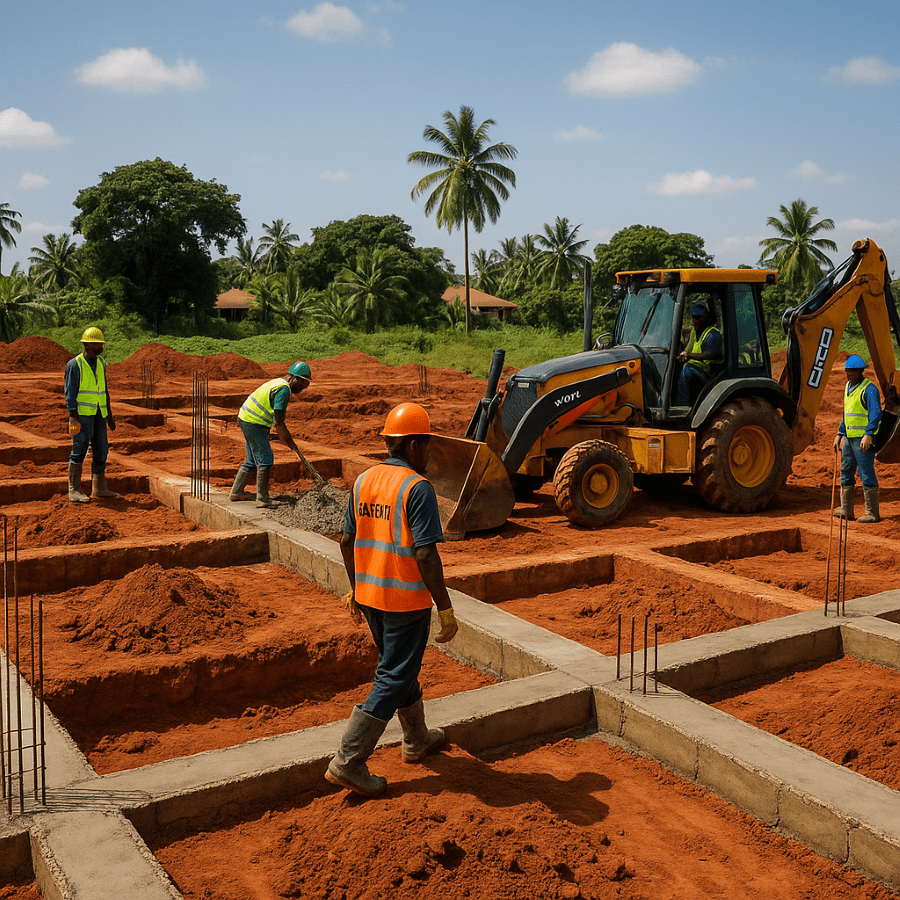
The foundation of any building is critical to its structural integrity, serving as the base that supports the entire structure. In Nigeria, where diverse soil conditions and varying construction needs present unique challenges, selecting the appropriate foundation type is essential. Among the various foundation types, shallow foundations are particularly prevalent in Nigerian building projects, especially for structures with relatively light loads and stable soil conditions. This article delves into the key applications of shallow foundations in Nigeria, exploring their advantages, types, and the factors influencing their use in the country’s construction industry. Shallow foundations are typically used when the soil near the surface has sufficient bearing capacity to support the structure’s load. These foundations are generally less than three meters deep and are designed to spread the load of the building over a larger area. Shallow foundations are commonly used for residential buildings, low-rise commercial structures, and other projects where the soil conditions are favorable, and the building loads are not excessively heavy. Shallow foundations come in various forms, each suited to different building types and soil conditions. The most common types used in Nigeria include: Description: Spread footings, also known as pad foundations, are individual foundations that support single columns. They are typically square, rectangular, or circular slabs of concrete that spread the load over a wider area of soil. Applications: Spread footings are ideal for smaller structures such as single-story residential buildings, small commercial buildings, and extensions to existing buildings. In Nigeria, spread footings are commonly used in regions with stable soil that can support light to moderate loads. Description: Strip footings are continuous strips of concrete that support load-bearing walls. They are wider than the walls they support and distribute the load evenly across the soil beneath. Applications: Strip footings are widely used in Nigeria for buildings with load-bearing walls, such as residential houses, schools, and low-rise office buildings. They are particularly effective in areas where the soil has a moderate bearing capacity. Description: A raft foundation, or mat foundation, is a large, continuous slab of concrete that covers the entire footprint of the building. It spreads the load over a vast area, making it suitable for buildings on weak or compressible soils. Applications: In Nigeria, raft foundations are commonly used for larger structures like multi-story residential buildings, industrial buildings, and warehouses. They are particularly effective in areas with poor soil conditions, where other shallow foundations might not provide adequate support. Shallow foundations are versatile and can be adapted to a variety of construction projects in Nigeria. The following are some key applications: Shallow foundations are the go-to choice for residential construction in Nigeria. The country’s rapidly growing population has led to a surge in demand for housing, particularly in urban and suburban areas. Spread footings and strip footings are commonly used for single-family homes, duplexes, and small apartment buildings, where the loads are relatively light, and the soil conditions are favorable. Shallow foundations are also widely used for low-rise commercial structures, such as retail stores, office buildings, and small hotels. In Nigeria, where the commercial real estate market is expanding, shallow foundations provide an economical and efficient solution for developers. Strip footings are often used to support the load-bearing walls of these buildings, while raft foundations may be employed for larger structures or those built on less stable soil. Public infrastructure projects, such as schools, health centers, and community halls, often utilize shallow foundations due to their cost-effectiveness and ease of construction. In Nigeria, government and non-governmental organizations frequently employ shallow foundations for these projects, particularly in rural and semi-urban areas where construction budgets may be limited. Raft foundations are sometimes used for larger public buildings that require more extensive support. Shallow foundations are commonly used for extensions and renovations to existing buildings. In Nigeria, where property owners often expand their homes or businesses, spread footings and strip footings are popular choices for adding new rooms, wings, or floors to existing structures. These foundations provide the necessary support while minimizing disruption to the existing building. The choice of shallow foundations in Nigerian construction projects is influenced by several factors, including: The bearing capacity of the soil is a critical factor in determining whether a shallow foundation is suitable. In Nigeria, soil conditions vary widely across different regions. Areas with stable, firm soil are ideal for shallow foundations, while regions with weaker or more compressible soils may require deeper foundations or specialized shallow foundations like raft foundations. The weight and distribution of the building load play a significant role in foundation selection. Shallow foundations are suitable for structures with lighter loads, such as residential buildings and low-rise commercial buildings. However, for heavier structures or those with uneven load distribution, deeper foundations may be necessary. Shallow foundations are generally more cost-effective than deep foundations, making them an attractive option for many projects in Nigeria. The lower cost of materials, labor, and construction time associated with shallow foundations makes them a preferred choice for budget-conscious developers and property owners. Environmental conditions, such as the presence of groundwater, seismic activity, and erosion, can affect the suitability of shallow foundations. In Nigeria, regions with high water tables or areas prone to flooding may require additional precautions, such as waterproofing or soil stabilization, when using shallow foundations. Building codes and regulations in Nigeria also influence the choice of foundation type. Compliance with local regulations ensures that the foundation design meets safety standards and provides adequate support for the structure. Shallow foundations must be designed and constructed following these guidelines to ensure the long-term stability of the building. Understanding the broader context of the Nigerian building construction process is essential for appreciating the role of shallow foundations. The construction process in Nigeria typically follows these steps: Before construction begins, a thorough site assessment is conducted to evaluate the soil conditions, topography, and environmental factors. Soil testing is a crucial part of this process, as it determines the soil’s bearing capacity and helps in selecting the appropriate foundation type. Based on the site assessment, architects and engineers design the building and its foundation. For projects using shallow foundations, the design will specify the type, dimensions, and reinforcement requirements of the foundation. Detailed plans are prepared, including structural drawings and load calculations. The construction process begins with the excavation of the site to the required depth for the foundation. For shallow foundations, this typically involves digging trenches or pits to a depth of less than three meters. The excavation must be precise to ensure that the foundation is laid at the correct depth and on stable soil. The next step is constructing the foundation itself. Depending on the type of shallow foundation, this may involve pouring concrete into molds or forms to create spread footings, strip footings, or a raft foundation. Reinforcement, such as steel bars or mesh, is often added to increase the foundation’s strength. After the concrete has been poured, it must be allowed to cure properly to achieve its full strength. Curing involves maintaining the moisture and temperature conditions of the concrete for a specified period. Once the concrete has cured, the foundation is backfilled with soil to provide additional support and protection. With the foundation complete, construction of the building’s superstructure can begin. The foundation provides a stable base for the walls, columns, and floors, ensuring that the building remains level and structurally sound as construction progresses. Upon completion of the construction, a final inspection is conducted to ensure that the building meets all safety and quality standards. The foundation is checked for any signs of settlement, cracking, or other issues that could compromise the building’s stability. Once the building passes inspection, it is handed over to the owner or developer. Shallow foundations play a vital role in the Nigerian construction industry, offering a cost-effective and efficient solution for a wide range of building projects. Their versatility makes them suitable for residential buildings, low-rise commercial structures, public infrastructure, and more. Understanding the different types of shallow foundations and the factors influencing their use is essential for successful construction in Nigeria. As Nigeria’s construction industry continues to grow, the demand for reliable and durable foundations will remain high. By carefully selecting the appropriate shallow foundation for each project, builders can ensure the long-term stability and safety of their structures, contributing to the country’s ongoing development and urbanization efforts. Understanding Shallow Foundations: Key Applications in Nigerian Building Projects
Introduction
Overview of Shallow Foundations
Types of Shallow Foundations in Nigerian Construction
Spread Footing (Pad Foundation):
Strip Footing:
Raft (Mat) Foundation:
Key Applications of Shallow Foundations in Nigerian Construction
Residential Buildings:
Low-Rise Commercial Buildings:
Public Infrastructure Projects:
Extensions and Renovations:
Factors Influencing the Use of Shallow Foundations in Nigeria
Soil Conditions:
Building Load:
Construction Costs:
Environmental Factors:
Regulatory Requirements:
The Nigerian Building Construction Process and Shallow Foundations
Site Assessment and Soil Testing:
Design and Planning:
Excavation:
Foundation Construction:
Curing and Backfilling:
Superstructure Construction:
Final Inspection and Handover:
Conclusion
 Conifer Konstruktion (Nig) Ltd has a project delivery track record of 60+ projects. Contact us via email (okoyeebubedike@coniferkonstruktion.com.ng) or phone (803) 404-0894, and we’ll make sure you’ll have a stress free construction experience.